


Key takeaways:
- If you advertise mortgage rates, you probably need to know about Regulation Z, the implementation piece of the Truth in Lending Act.
- If you use a trigger term when advertising a mortgage rate, it triggers disclosure requirements from Reg Z. You then have to pair that rate with specific additional info.
- Closed-end loans like mortgages, refinances, and home equity loans have different disclosure requirements than HELOCs.
- Using a configurable rate display that includes the required disclosures makes all of this easier to manage.
Mortgage advertising trigger terms.
Does hearing those four words trigger you? If so, you’re probably in the mortgage lending game.
The Truth in Lending Act (TILA) did a lot to protect consumers. But in doing so, it definitely made mortgage advertising more complicated. Now, if you use a specific word or phrase, you might be legally required to pair it with certain disclosures. Navigating these trigger terms can feel challenging for even the most seasoned mortgage pro.
We want to help. So today, we’re going to get into the details of Regulation Z. That’s the implementing regulation behind TILA. Reg Z is what establishes advertising disclosure requirements for mortgage lenders.
The requirements vary a little bit between closed-end loans (e.g., mortgages, refinances, and home equity loans) and open-end loans (e.g., HELOCs). Let’s look each of them, starting with closed-end loans because those likely cover the bulk of your business.
Advertising trigger terms for mortgages, refinances, and HELOANs (closed-end loans)
Before we get into all of this, we want to call out one far-reaching Reg Z requirement for closed-end loans. Any time you advertise an interest rate, it always needs to be paired with an APR. And you can’t tuck that away, either. The APR needs to be just as visible as the interest rate.
Anywhere you advertise mortgage rate and APR information, you run the risk of a trigger term. With closed-end loans, you can trigger Regulation Z requirements if you share the:
- Repayment period or number of payments (e.g., 30-year fixed-rate mortgage, 180 monthly payments)
- Payment amount (e.g., payments as low as $X/month)
- Amount of any finance charge (e.g., $500 total cost of credit, $200,000 loan with two points, $2,000 in finance charges)
Note that you do get a tiny amount of wiggle room here. With closed-end loans, you’re allowed to use zero without it triggering additional disclosures. Saying things like “no closing costs” doesn’t trigger Reg Z disclosures, even though you’re specifying a $0 total.
(There’s one more thing to note to avoid confusion if you look at Regulation Z yourself. The rules here also include down payment amounts as a trigger term. But that specifically applies to credit sale transactions. You shouldn’t have anything to worry about in the mortgage space.)
What happens if you trigger Regulation Z for a closed-end loan
If you advertise a rate in a way that triggers Reg Z, you step into territory where you have to pair that advertisement with specific disclosures. For any of the above triggers, closed-end loans also need to be paired with three things:
- The down payment amount or percentage
- Repayment terms for the full loan term (including any balloon payment, if applicable)
- The APR and whether it can go up in the future
- Note: You need to call the APR the “APR” or “annual percentage rate.” There’s no clever wording workaround here.
This is a very high-level overview. Regulation Z is a pretty dense document, and it contains a lot more rules. If you’re advertising a loan with a variable rate (that includes ARMs), a promotional payment option, or anything else specialized, take some time to understand the required disclosures.
Additionally, if you used specific payment amounts in your advertising, be mindful of what Reg Z requires. If that payment amount didn’t include taxes or insurance, you likely also need to make a note letting the consumer know their actual payment could be higher.
Regulation Z requirements for HELOCs
If your lending institution offers and advertises home equity lines of credit, be advised that some extra Regulation Z rules come into play.
For starters, if you advertise a promo rate, you typically need to say how long the introductory rate lasts and the APR that applies afterward. You can’t bury this in the footnotes. Reg Z requires that it be displayed with equal prominence.
If the HELOC allows for a minimum payment and that could result in a balloon payment, you’re also required to disclose that.
Finally, you can’t call the HELOC “free money” and if you make certain tax claims, you have to recommend that they consult a tax advisor.
Beyond that, specific terminology can land you back in trigger term territory.
HELOC trigger terms
Regulation Z treats open-end credit differently than closed-end loans. For HELOCs, advertising specific financing terms can trigger additional disclosure requirements. Those include:
- APRs
- Specific fees and finance charges
- Payment amounts and repayment terms, including the length of the draw or repayment period
Even advertising a fee of $0 can trigger disclosures with a HELOC. For example, saying "no closing costs" can activate additional requirements, even though you're advertising the absence of a charge.
HELOCs also have special advertising rules for promotional rates, promotional payments, and certain balloon payments. Depending on the terms you're advertising, you may need to provide additional information beyond the standard disclosures.
Regulation Z compliance, the easy way
Keeping some major points in mind makes it a lot easier to satisfy Reg Z’s requirements. The two major takeaways here are as follows:
- Give people clear information with the appropriate context: Pair advertised rates with their APRs, loan terms, and other pertinent details.
- Avoid misleading information: If you’re sharing anything as an example, like a payment amount, make sure all of the associated terms and assumptions are included.
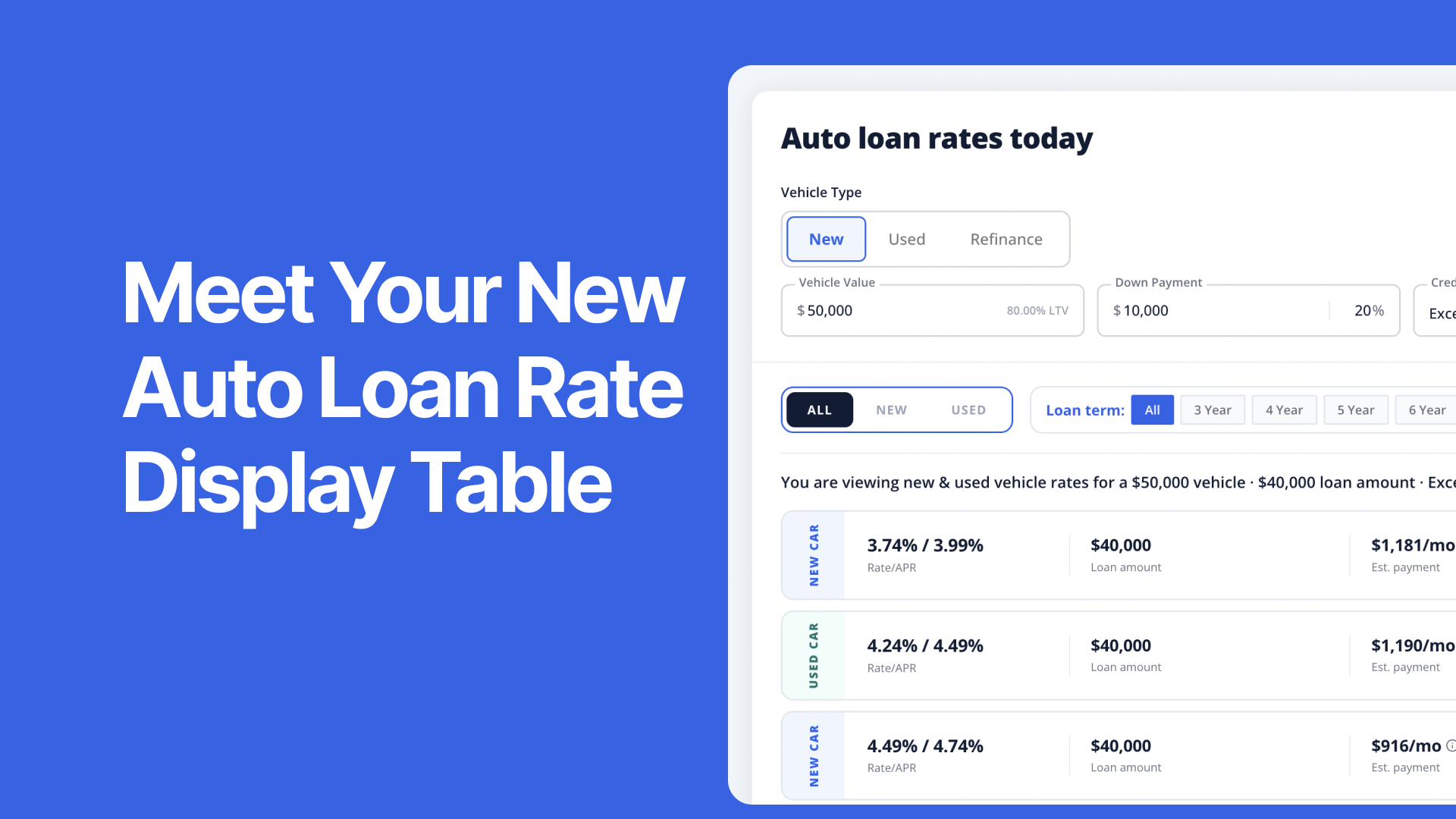
We can help here. We have pre-formatted rate display tools that feature key Regulation Z disclosures as prominently as necessary.
Plus, these tools connect straight to your pricing engine. This way, your rate tables, calculators, etc. don’t lag behind the rates you can actually offer. That helps you avoid presenting borrowers with misleading information.
Regulation Z and its trigger terms are complicated. Compliant mortgage rate advertising doesn’t have to be. To explore this in more detail with our team, book a demo today.