



.svg)
.svg)
.svg)

.svg)


.svg)

For lenders operating in 2026, mortgage pricing engines provide powerful tools. A good engine gives your loan officers access to real-time rates from a variety of sources, then allows them to price the loan scenario to the lead in mere moments. Internally, this changes the game.
But the benefits don’t have to stop there. You can use your pricing engine to power live mortgage rate tables on your website. This functions as both a borrower empowerment and lead generation tool. And, when done right, it gives you a way to showcase what you can offer without anyone on your team having to manually update your site.
The key to connecting rates from your pricing engine to your website lies in application program interfaces, or APIs. These tools allow you to feed rates straight from your pricing engine to consumers in rate tables branded to your lending institution.
Why live mortgage rate tables matter for lenders
Why would you want to display your rates? Some lenders feel like that’s giving away their secret recipe. In reality, though, it’s a necessity to stay competitive in 2026.
The big players — from Wells Fargo to Bank of America — use rate tables to their advantage. And when today’s consumer goes online, they expect near-instant access to the information they want. If they can’t find what they’re looking for on your website, you better believe they’ll go elsewhere.
By displaying live rates, you:
- Stay in competition with national lenders
- May potentially edge out your local competitors who don’t have live rates
- Keep potential borrowers on your website longer
- Showcase your lending institution as one that’s in the know
- Highlight that transparency is important to your team
- Reduce the workload for your loan officers
To realize all of those benefits, it matters that the rates are live, not delayed. You need to show what you can actually offer. Anything higher will drive leads away. Anything lower means disappointment when you actually quote them, again encouraging them to leave.
Fortunately, that’s where APIs come in. By using an application programming interface, you can make sure your website always displays the most updated rates available from your pricing engine.
Building your mortgage rate widget the easy way with RateFlow
Some pricing engines include API functionality. That means they may offer APIs that can feed to your website. If you’re going to set this up on your own, there are a few things you need to keep in mind. Those include proxying through your server to provide the required IP whitelisting and establishing some kind of scenario template so results get returned in a consistent format.
If that sounds a little too technical for your liking, you have another option. We offer RateFlow, a ready-made API designed to help lenders connect their pricing engine to their website.
RateFlow is our pricing and rate-delivery API layer. We’ve built it to connect with a range of pricing engines, including:
- Optimal Blue
- Loansifter
- Mortech
- Polly
- Lender Price
- LoanPASS
- Mortgagebot
We also do all the configuration for you. We make sure RateFlow delivers consistent, easy-to-understand information about rates to your borrowers. In addition to powering live mortgage rate tables, the RateFlow API can help you deploy personalized rate dashboards, rate alert emails, and more.
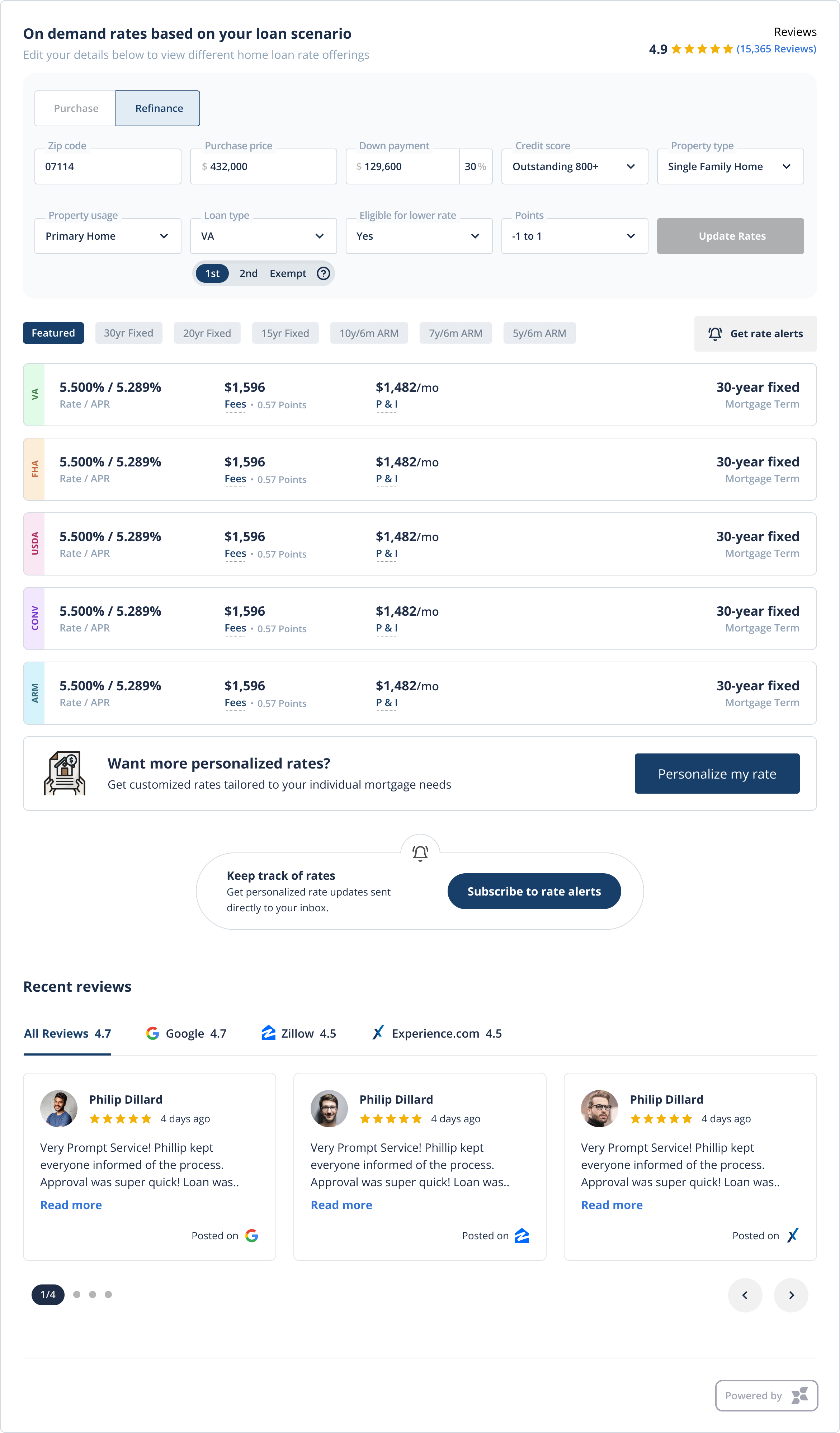
Inputs and outputs with RateFlow
To give you a better idea of how pricing engine APIs like RateFlow work, let’s walk through its process of showcasing rates to leads.
Say you have a rate table on your site that allows leads to see rates personalized to them (we can help you set that up). RateFlow pulls information in, accepting the loan scenario that the lead enters, including:
- Loan amount
- Loan purpose
- Credit score
- Occupancy
- Loan term
Then, RateFlow feeds that information to your pricing engine. In seconds, it returns a priced loan scenario to the lead. We can tailor the output to your preferences, but that typically includes:
- Rate
- APR
- Points
- Estimated monthly P&I payment
- Lock period details
- Eligibility notes or flags, like the need for mortgage insurance
We also work with you to make sure RateFlow includes all of the required disclosure fields. This way, you can showcase rate data and still keep your lending institution compliant.
Using your live mortgage rate widget to generate leads
Lenders who resist having live rates displayed online typically align with the sentiment: people won’t buy the cow when they can get the milk for free. But you can make sure that leads pay for their milk, so to speak.
Specifically, you can configure your pricing engine API to power both soft-personalized tools and full quote tools.
Soft-personalized tools let you showcase rates based on limited inputs, like the borrower’s zip code and estimated credit tier. To get a full quote, though, you can require people to go through a lead workflow. This allows you to get the information you need to provide them with an accurate quote and, at the same time, secure their contact information.
With a pricing engine API in play, your full quote tool can deliver an instant rate quote to the borrower. This caters to the modern consumer’s expectation to be able to get the information they want right when they want it.
But you don’t have to leave that quote just hanging there. Because the lead workflow collects contact information, your loan officer can get in touch — and be set up for success when they do. Because the lead has already shared key details about their borrowing needs, your LO can personalize their outreach and offers.
The big takeaway here is that lenders can use an API connected to their pricing engine to deliver a range of customer-facing tools, including live mortgage rate widgets. APIs give you a way to power lead generation tools on your website. At the same time, they help you compete with large national lenders offering real-time rate information on their own sites.
The best part is that getting your pricing engine API set up doesn’t have to be a lot of work or require technical expertise. With the RateFlow API, we make it easy to tap your pricing engine to power rate tables, personalized rate dashboards, and full rate quotes backed by lead workflows.
To see how all of this could work for your specific lending institution, book a demo with our team.

%20Tell%20the%20Two%20Apart.png)