



.svg)
.svg)
.svg)

.svg)


.svg)

Maybe you’re tapping into mortgage lead providers. Maybe you’re getting a lot of leads through your website’s workflows. Maybe you’re a well-established lending institution in the community, and people come to you organically. Whatever the case may be, if you’ve got a lot of leads, you’ve got a good problem on your hands.
Still, it can be a problem. When too many contacts are in your loan officers’ Rolodex, they might spend too much time on one lead while ignoring another. And if that energy isn’t being directed in the right places, you might miss opportunities to convert.
Here, mortgage lending companies can turn to lead scoring systems. And if they really want to see benefits, they can choose AI lead scoring. Here are a few ways using AI helps the tool beat out rule-based systems.
#1: Smarter analysis of signals
Traditional lead scoring systems use set parameters to determine a lead’s status. The rules that determine a lead’s score might be pretty simple. Did they open an email from you in the last week? Yes or no.
The set, straightforward rules don’t leave a lot of room for the complexity that often comes with each individual’s borrowing scenario.
AI gives you a different path forward. Artificial intelligence can gather information from a wider range of sources and weigh different data points more strategically. It knows, for example, that someone clicking the “Apply Now” button warrants a higher score than clicking a “See Rates” button.
Because AI can intelligently process conversion signals, it helps you get a score that’s much more reflective of the lead’s actual likelihood of closing.
Just as importantly, AI lead scoring operates dynamically. That means it continues analyzing and weighing signals over time. With regular lead score updates, it helps your loan officers stay informed about where each lead is at today.
#2: Speed and scalability
On the one hand, the sales cycle for mortgages tends to progress a lot slower than, say, for retail products. On the other, consistently moving mortgage rates mean that nothing stays fixed for long. That makes mortgage lead scoring complicated. You need tools that can provide an accurate picture over the longer sales cycle while factoring in market volatility.
AI helps you handle all of this. With artificial intelligence in play, your team gets a way to analyze and synthesize data quickly. This helps you keep up with rate changes.
At the same time, AI can apply the data analysis to the sales cycle timeline that’s right for each lead. If the lead hasn’t provided any timeline information, it uses the typical 1–2 month cycle. But if a lead has said they’re trying to buy fast or they need a quick close, it can score the lead accordingly. That means assigning a higher score to flag it for your loan officer as one that’s likely to convert — and soon.
#3: Improvement over time
Rule-based lead scoring systems are static. Unless you retool the rules behind them, they’re going to give you the same scores over time.
Artificial intelligence is different. It’s like human intelligence in that it grows over time. As the AI lead scoring model evaluates leads, it also watches how those leads perform. Does the hot lead actually close?
This helps it see what works for your unique team. It gets better at understanding lead behaviors in the specific market(s) you serve, too. This helps you get increasingly accurate lead scores over time.
#4: More info your team can use
Traditional lead scoring models are designed to deliver one thing: a numerical score. That score helps your team see which leads should be the highest priority. Still, the loan officer then needs to jump in your CRM, go back over emails, or look at their notes to understand that unique borrowing scenario.
With AI lead scoring, you can get more than just a score. This lead scoring model isn’t just an equation into which you plug different data inputs. It’s a system that takes a holistic view of the lead based on all of the data your company has.
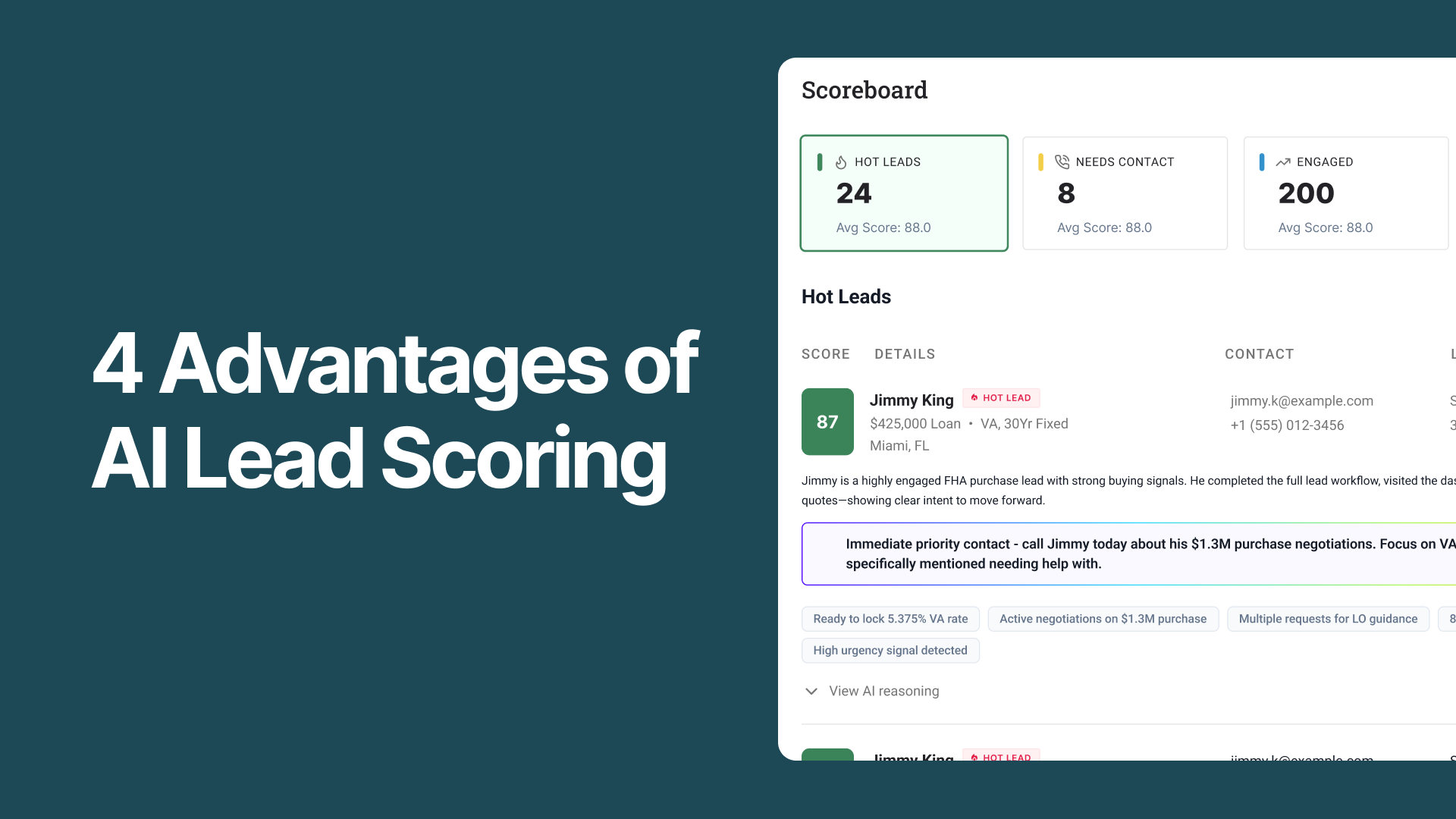
That means it can equip your loan officers with an overview. The AI lead scoring system might provide a quick summary of the lead’s latest actions or note that your team should reach out in the next 24 hours. By providing more than a number, it gives your loan officers more context. That helps them make strategic decisions about which borrowers they engage with when.
Bonus: Getting even more with AI lead scoring built for mortgages
AI lead scoring is changing the game. But not all models are created (or developed) equal. Unlocking optimal outcomes means choosing AI lead scoring that was developed specifically to analyze and interpret mortgage leads.
That’s what you get with Scoreboard. We purpose-built this scoring system to serve companies that offer home loans. That means it’s already designed to understand the unique length of the mortgage sales cycle and to factor in the volatility of the rate environment.
Better still, we developed Scoreboard to make it easy to plug in all of the data your company gets from leads. It can factor in:
- Website visits and clicks
- Email opens and clicks
- Rate quote history
- SMS texts with loan officers or your AI textbot
- Usage of your website calculators
- Engagement with your website chatbot
- Anonymous session activity once the lead submits information
Scoreboard also gives added weight to high-intent actions like clicking “Apply Now.” It’s designed to capture the many ways leads engage with mortgage information and to value different signals appropriately. That means your loan officers get a more accurate, informative score.
Beyond that, Scoreboard includes plain-English summaries of each lead and suggested next actions. All of this helps to equip your team to put the right energy behind the right lead at the right time.
If you want to see what Scoreboard can do, we’re more than happy to provide a demo. To book some time with us to explore AI lead scoring for your mortgage lending team, use our scheduling tool.

%20Tell%20the%20Two%20Apart.png)